

Facetious, as per. But I got you!
I’ve been studying ADHD as a central part of my PhD for the past few years, specifically by taking an individual differences approach in non-clinical samples. That means I don’t typically run experiments comparing people with an ADHD diagnosis to people without one (ethics is too long). Instead, I run experiments on everyone and correlate their results with an ADHD trait score, which is basically a summed-up measure of symptom severity based on the criteria in the Diagnostic and Statistical Manual (DSM).
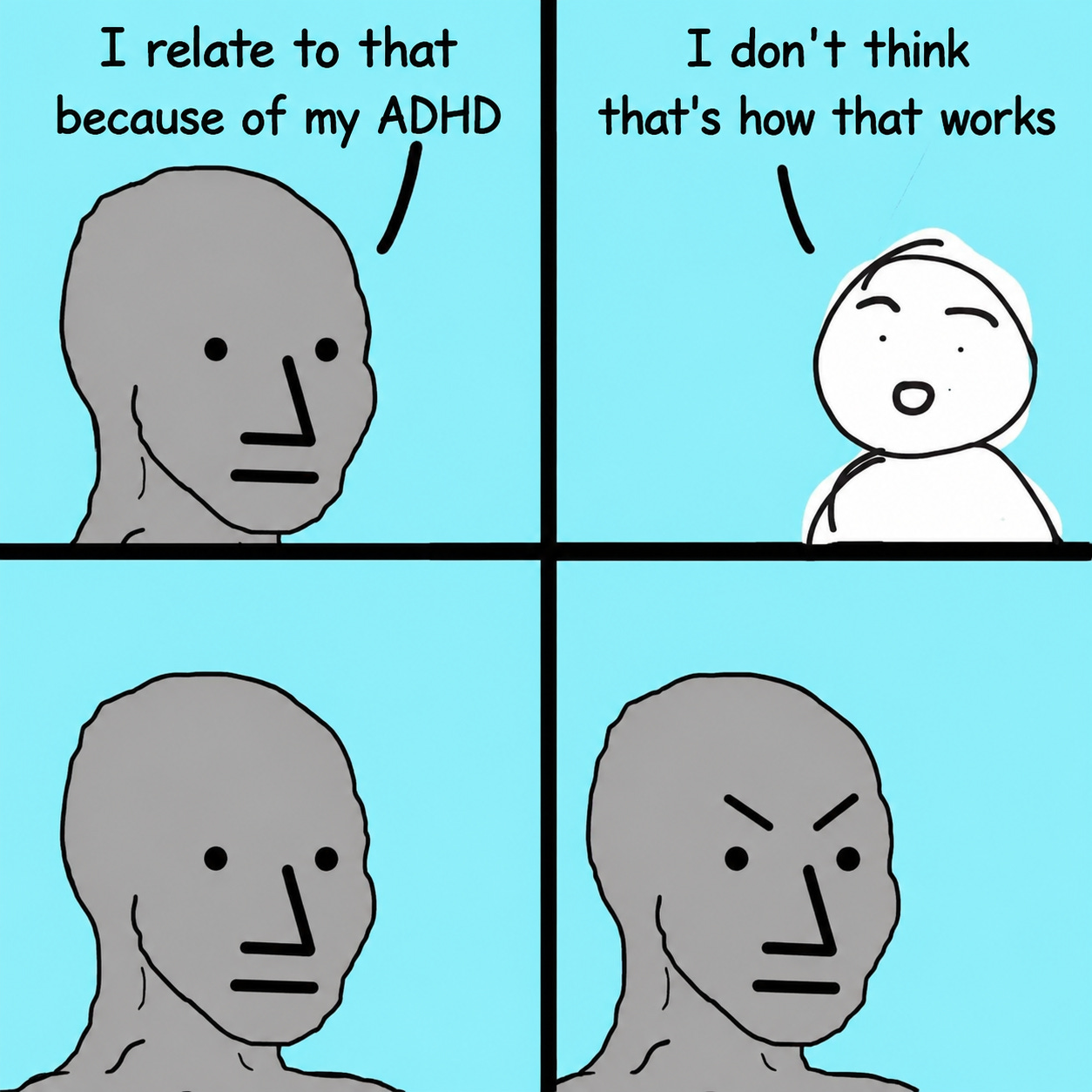
There are a few reasons this approach works well. Mainly because cognitive functions like attention exist on a spectrum across the population, with disorders like ADHD representing one end of that continuum rather than a distinct category. ADHD is highly heritable and influenced by a silly number of genes, each contributing teeny-tiny effects that sum together to generate your specific polygenic (literally, many-gene) risk. The genes involved are distributed normally (i.e., following a beautiful Gaussian distribution) throughout the general population, and give rise to ADHD-like traits that show up as measurable differences in attention and behaviour in psychology experiments.
But what’s an ADHD-like behaviour? Like, not listening to me when I speak, or forgetting where they put their phone?
Well, yes, kind of. Maybe both, maybe one or the other, or maybe neither!
The thing is, ADHD has what we call a heterogeneous presentation — meaning it looks different for everyone. I have a whole spiel, about five chapters long, that goes deep on my specific take on ADHD, what it is and how we measure it. But Substack is for sharing my bad ideas, not my good ones, so I’m not going to disclose the central theme of my whole ass PhD for free online.
But still, think of a list of symptoms. Symptoms 1 through 3 could look like a completely different disorder day-to-day from symptoms 4 through 6. Factor in each person’s specific environment and we’re basically dealing with different disorders entirely. Our modern conception of ADHD has tried to account for this with subtypes, which neatly split the disorder based on symptom presentation. Great, right?
WRONG.
The antidote to heterogeneity isn’t more categories, you freak. What this categorical approach misses is the potentially vibrant inner world of each person’s specific bio-psycho-social phenomenological cocktail of experience. If we actually want to tackle heterogeneity, we should look at what symptoms people are experiencing and meet them where they’re at.
Well, what’s a symptom?
Great question!
Take something like often loses things necessary for tasks or activities. This is one of the symptoms used to diagnose ADHD, alongside things like difficulty sustaining attention, being easily distracted, interrupting people, and struggling to remain seated. But these aren’t little pieces of ADHD that we’ve discovered; they’re descriptions of behaviour. We observe that someone frequently loses things, struggles to sustain attention, interrupts people, and experiences a collection of other difficulties. If enough of these behaviours occur frequently enough, for long enough, and cause sufficient impairment, we give that pattern a name: ADHD.
This distinction sounds pedantic until we start saying things like Charlie constantly loses his keys because he has ADHD. Okay, but how do we know Charlie has ADHD? Well, in part, because the silly prick keeps losing his keys. We’ve accidentally started using the label we gave to a collection of behaviours as an explanation for those same behaviours. This is reification: treating an abstract construct as though it were a concrete thing. Psychology fucking looooves doing this.
It also raises a slightly awkward question: where exactly does ADHD begin? Imagine, for the sake of argument, that we could perfectly measure ADHD severity from 0 to 100. You score 72, I score 71, and some committee of extremely clever people has decided that 72 is where ADHD starts. Congratulations — you have ADHD and I don’t. Presumably, somewhere between 71 and 72, your brain underwent a profound neurological transformation. Except, obviously, it didn’t.
That’s the sense in which ADHD is “made up.” The symptoms aren’t made up, the impairment isn’t made up, and neither are the biological and genetic influences underlying them. We made up the category. We took dimensions along which humans already vary — attention, impulsivity, activity, organisation, and so on — identified a sufficiently impairing region of that variation and drew a boundary around it. That boundary can be extremely useful without being a natural dividing line between two fundamentally different kinds of people.
And this is where the title becomes slightly less stupid. Everybody doesn’t have ADHD, but everybody exists somewhere on the dimensions from which we construct it. Everyone gets distracted, forgets things, procrastinates, and loses their keys; what matters clinically is the severity, persistence, combination, and impairment associated with those experiences. Everyone pisses, too. But if you’re doing it 45 times a day, I’d probably go see a doctor.
Thinking about ADHD this way changes the question from does this person have ADHD? to what is this person actually struggling with? Two people can arrive at the same diagnosis through very different collections of symptoms, interacting with very different environments, and consequently experience what looks, day-to-day, like a completely different disorder. If heterogeneity is the problem, endlessly subdividing the category might not be the solution. Perhaps the more interesting place to look is below the diagnosis, at the symptoms themselves and the people experiencing them.
Which takes me into my top ten favourite things to talk about… NETWORK PSYCHOMETRICS!!!!!
I absolutely fucking LOVE network psychometrics. I went to a week-long workshop in Amsterdam this February to train in it, and it was genuinely a highlight of my year. My dream blunt rotation is Sacha Epskamp, Eiko Fried, Denny Borsboom, and Maarten Marsman. And you know it’d be good, too, because they’re all Dutch.
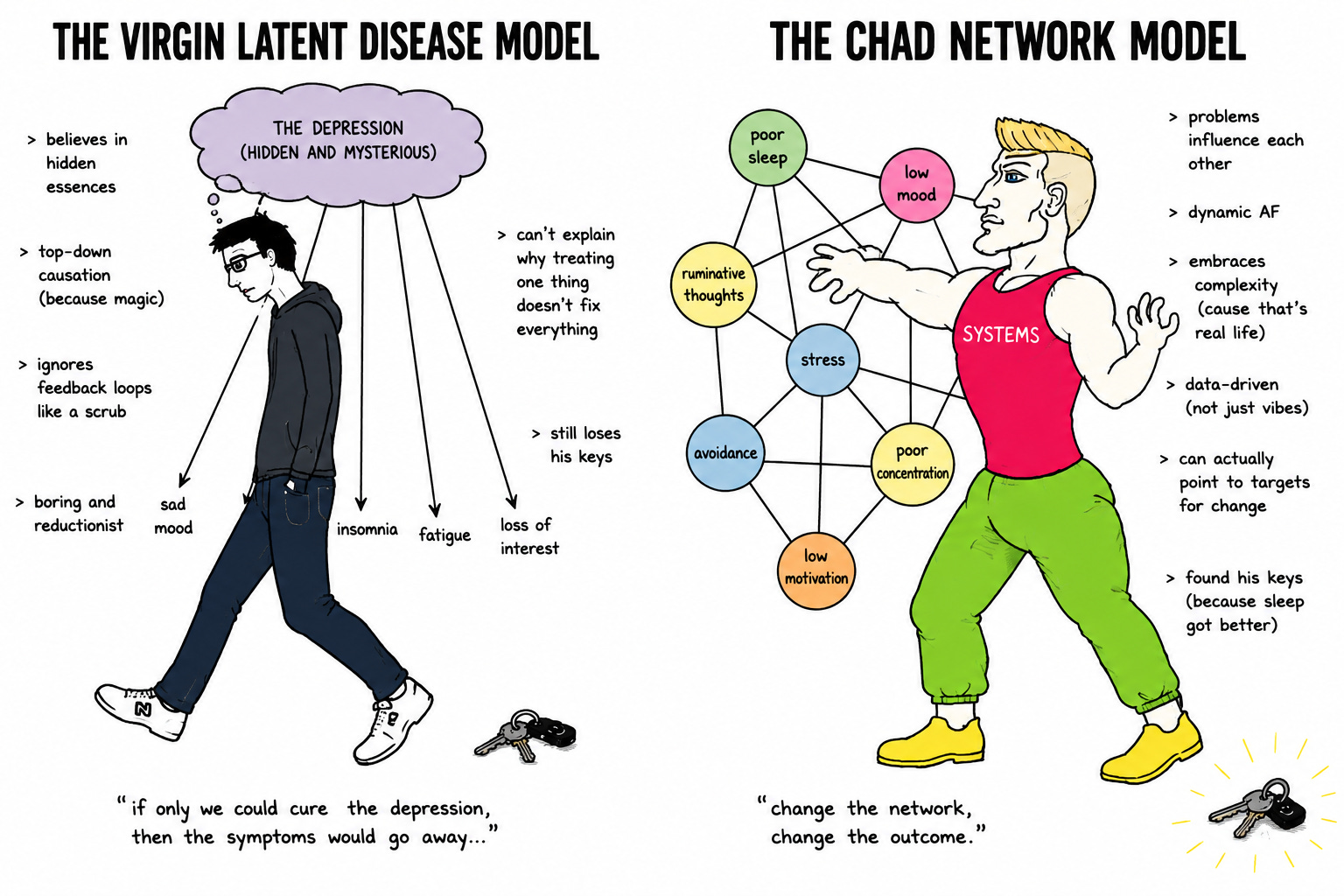
I could talk about networks all day, but I won’t. Here’s the theoretical essentials: instead of assuming a hidden “ADHD” entity that independently produces inattention, impulsivity and disorganisation, you map how those problems relate to each other directly — symptoms as nodes, their relationships as edges — no hidden entity required. It’s a genuinely different way of thinking about what a disorder even is, and it deserves its own article rather than a paragraph wedged into this one. Consider this the trailer; full breakdown coming soon.
It’s worth mentioning that I first got interested in ADHD because I saw hundreds of TikToks insisting that things I considered perfectly normal behaviours were, in fact, signs of ADHD. I found this so intriguing that I drafted up a proposal and applied to do a PhD on symptom-based approaches to neuropsychological testing for ADHD. If I’m honest, what really got me about the TikToks wasn’t curiosity about the disorder, but rather the irritation of watching ordinary behaviours get repackaged as a diagnosable condition. There was just no way that was the case. Right? Well, scientists must admit when we’re wrong. And, as much as I still dislike that culture of pathologising normal behaviour, they’re kind of right. What makes ADHD symptoms isn’t because they fit in some magical box. Sure, the behaviours cluster together statistically, but the DSM is a diagnostic tool, not an exhaustive list. If a behaviour related to attention, inhibition or hyperactivity is causing some kind of impairment in your life, then yeah, it could be your particular phenotypic presentation of ADHD.
Here’s the thing: the symptoms are made up too, in the sense that they’re just words for ordinary human experiences. Losing focus, forgetting things, feeling restless. These aren’t secretly ADHD-flavoured phenomena reserved for people with a diagnosis. They’re just things brains do. What actually separates “I lost my keys” from “I have ADHD” was never the presence of the behaviour. It’s the degree of impairment — how much it’s costing you, how often, for how long, etc.
Wow, aren’t I brave and admirable scientist for doing research and admitting I was wrong. Go me!
Anyway, hopefully you got something from that. If not, read my thesis it’s kind of like this but waaay better.
(P.S., I used AI to help me write this. But don’t worry, I myself am not a robot.)
A lot of very high functioning young people I know (men, mainly) have pursued diagnoses and treatment for ADHD. They held down good jobs and had good academic results. I do find it odd that they pursued diagnoses. Almost like it was a self improvement thing rather than treating a neurodevelopmental condition.
So unrelated but "The antidote to heterogeneity isn’t more categories, you freak." made me laugh.
Signed: Me as a genetic counselor when a phenotypically heterogeneous condition is broken into 15 subtypes all caused by the same gene (or few genes) and there aren't even any established genotype-phenotype correlations by subtype